Maltodextrin - hidden sugar

Sugar in Disguise: What Food Companies Don’t Tell You About Maltodextrin

Maltodextrin: The “Safe” Ingredient That Tricks Us

Have you ever spotted maltodextrin on a food label and wondered what it really is? At first glance, it seems harmless—after all, it doesn’t even sound like sugar. But here’s the catch: maltodextrin is one of the most common hidden sugars in today’s food industry.

While food companies prize it for its versatility, consumers need to understand what it is, how it works in the body, and why it may not always be as “safe” as it seems.


What Is Maltodextrin?

Maltodextrin refers to two forms of glucose polymers (also called dextrose polymers or dextrins):

  • Digestible maltodextrin – produced through enzymatic breakdown of starches such as corn, rice, potato, or wheat. It is rapidly absorbed and acts as a quick energy source.

  • Resistant maltodextrin – engineered to resist digestion, functioning as a soluble dietary fiber fermentable in the colon, supporting gut health.

The manufacturing process typically involves:

  1. Cooking starch until it begins to break down.

  2. Applying enzymes (like amylase) to reduce it into shorter glucose chains.

  3. Drying the mixture into a fine, white powder.

Because it is inexpensive, neutral in taste, and dissolves easily in water, it has become a staple in the global processed food industry (Wikipedia).


Taste & Texture

Maltodextrin has several functional properties that make it attractive to manufacturers:

  • Neutral to slightly sweet taste (less sweet than sugar)

  • Dissolves quickly in hot or cold liquids

  • Adds bulk and improves texture without altering flavor

  • Prevents crystallization, stabilizing shelf life

This explains why maltodextrin is often hidden in products that don’t even taste sweet.


Common Uses in Food

Maltodextrin shows up in a wide variety of products, including:

  • Sports nutrition: energy gels, drinks, protein powders

  • Baked goods: cakes, pastries, cookies

  • Instant foods: soups, puddings, oatmeal

  • Sauces & dressings: for thickening and emulsifying

  • “Low-fat” or “sugar-free” items: to replace texture lost when fat or sugar is removed

For manufacturers, it is a “multitasker” ingredient—cheap, functional, and nearly invisible to consumers.


Nutritional Profile & Glycemic Impact

Maltodextrin is a carbohydrate, but its glycemic index (GI) makes it controversial:

  • Maltodextrin GI: 85–105

  • Table sugar (sucrose) GI: ~65

  • Glucose GI: 100

This means maltodextrin can spike blood sugar faster than table sugar, leading to sudden insulin surges. For people with diabetes, insulin resistance, or those managing weight, this is a red flag.


Why Athletes Use Maltodextrin

Not all uses are negative. In sports and medical nutrition, maltodextrin serves a practical role:

  • Post-exercise recovery – rapidly replenishes glycogen stores in muscles.

  • Weight-gain supplements – provides calorie-dense energy without excessive sweetness.

  • Medical nutrition formulas – included in feeding tubes and specialized shakes for patients needing easily digestible energy.

For endurance athletes, it’s a strategic energy tool. For the average consumer, however, it often represents hidden sugar intake.


Health Pros and Cons of Maltodextrin

Potential Benefits

  • Quick energy source for athletes and patients.

  • Improves texture in reduced-fat or reduced-sugar foods.

  • Easily digested when fast fuel is needed.

  • Resistant type can support gut health by acting as dietary fiber.

Potential Risks

  • Blood sugar spikes – risk for diabetics or those with metabolic syndrome.

  • Hidden sugar intake – sneaks into foods marketed as “healthy” or “sugar-free.”

  • Gut health concerns – some studies suggest it may negatively alter gut bacteria or trigger inflammation in sensitive individuals.

  • Weight gain – adds calories without fiber, vitamins, or minerals.


Safety Status

The FDA classifies maltodextrin as GRAS (Generally Recognized as Safe). But “safe” in this context means non-toxic at typical consumption levels—not necessarily “healthy.”

  • Moderate intake in occasional foods = generally safe.

  • Frequent, hidden intake in processed foods = potential health risk.


Bottom Line

Maltodextrin is a processed carbohydrate widely used as a food additive, thickener, and quick energy source.

  • For athletes, it can be a helpful recovery tool.

  • For the average consumer, it often acts as a hidden sugar, raising blood glucose faster than table sugar and adding empty calories.

Key takeaway: Always check ingredient lists. Even foods labeled “sugar-free” or “healthy” may contain maltodextrin.


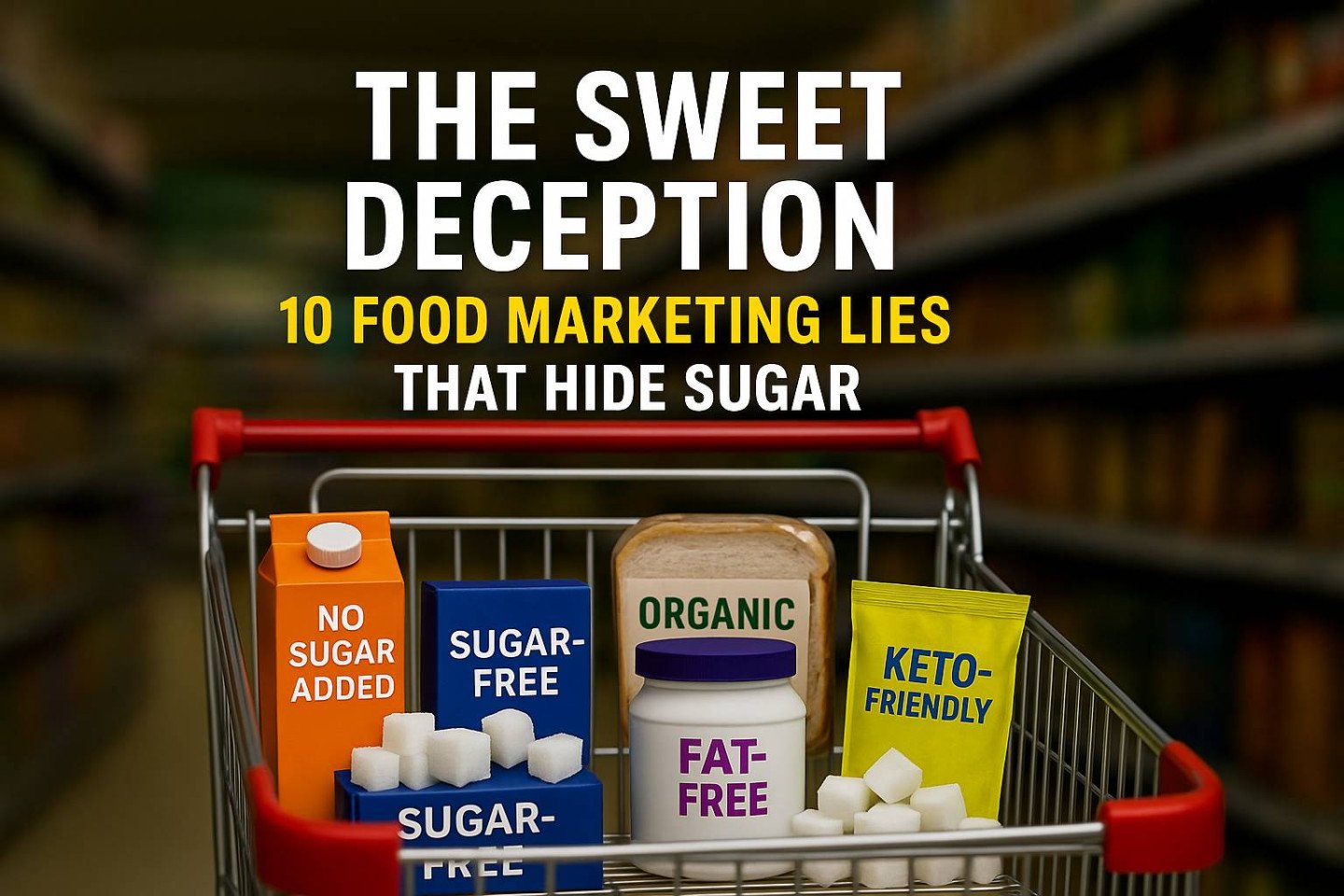
10 Food Marketing Lies About Hidden Sugars

1. “No Sugar Added”

The Lie: Sounds safe, right?
The Truth: It only means no table sugar (sucrose) was added. These foods often contain fruit juice concentrate, maltodextrin, or corn syrup.
Example: Fruit juices labeled “no sugar added” can carry as much sugar as soda.


2. “Sugar-Free”

The Lie: Zero sugar = zero guilt.
The Truth: These foods often contain maltodextrin, dextrose, or sugar alcohols that still raise blood sugar.
Example: Sugar-free candies and chocolates often rely on sugar alcohols plus maltodextrin.


3. “Fat-Free” or “Low-Fat”

The Lie: Healthier because fat is removed.
The Truth: Sugar or maltodextrin is usually added back to replace flavor and texture.
Example: Fat-free yogurts can contain more sugar than full-fat versions.


4. “Made with Whole Grains”

The Lie: Heart-healthy and wholesome.
The Truth: Many products are still mostly refined flour and sugar, with only a touch of whole grain.
Example: Breakfast cereals boasting “whole grains” but still packed with sugar.


5. “All-Natural” or “Natural Sweetener”

The Lie: Natural means healthy.
The Truth: Natural doesn’t mean harmless. Agave nectar, coconut sugar, or honey are still sugar.
Example: Snack bars sweetened “naturally” can still load your body with sugar.


6. “Organic”

The Lie: Organic = healthier.
The Truth: Organic cane sugar or syrup is still sugar.
Example: Organic cookies may use “organic sugar” but are still sugar-heavy.


7. “Low-Carb” or “Keto-Friendly”

The Lie: Safe for low-carb diets.
The Truth: Many “net carb” products subtract fiber or sugar alcohols but still include starches like maltodextrin.
Example: Keto snacks with “3 net carbs” but hiding 20 grams of total carbs.


8. “Serving Size Manipulation”

The Lie: Only a small amount of sugar per serving.
The Truth: Labels shrink serving sizes to make sugar appear lower.
Example: Instant oatmeal packets may look harmless, but most people eat two at a time.


9. “Zero-Calorie” Sweeteners

The Lie: No calories means no problem.
The Truth: Many “zero-calorie” sweeteners use maltodextrin as filler.
Example: Stevia or sucralose packets often contain more filler than the sweetener itself.


10. “Light” or “Diet”

The Lie: Lighter means healthier.
The Truth: These versions often swap fat or sugar with hidden fillers and artificial additives.
Example: Light sauces and dressings often rely on maltodextrin and corn syrup solids.


How to Outsmart Hidden Sugars

  1. Ignore the front label. That’s where the marketing lies live.

  2. Go straight to the ingredients list. Hidden sugars are often right there.

  3. Watch out for: maltodextrin, dextrose, glucose syrup, corn syrup, fruit concentrates, syrups, or anything ending in “-ose.”


Final Takeaway: Don’t Be Fooled by Sweet Lies

Food companies are experts at disguising sugar. Maltodextrin may be FDA-approved, but it’s still one of the sneakiest ways sugar hides in “healthy” foods.

The truth is simple: marketing sells comfort, but labels tell the truth. Next time you shop, flip the box, read the fine print, and don’t fall for sweet deception.

Because the sweetest lies are the ones hiding in plain sight.

#HiddenSugars #FoodMarketingLies #HealthyEating #SugarFreeMyth #NutritionTips

Drink Devotional Method A Light That Shineth in a Dark Place (2 Peter 1)

Drink Devotional Method: A Light That Shineth in a Dark Place (2 Peter 1)

Today, we turn to 2 Peter chapter 1—a rich reminder that we have not followed cunningly devised fables but are called to walk in truth and grow in godliness. Let us read and reflect on the passage with open hearts as we allow God’s Word to be a light that shineth in a dark place.


D – Devotional Reading

2 Peter 1 (King James Version)

1 Simon Peter, a servant and an apostle of Jesus Christ, to them that have obtained like precious faith with us through the righteousness of God and our Saviour Jesus Christ:
2 Grace and peace be multiplied unto you through the knowledge of God, and of Jesus our Lord,
3 According as his divine power hath given unto us all things that pertain unto life and godliness, through the knowledge of him that hath called us to glory and virtue:
4 Whereby are given unto us exceeding great and precious promises: that by these ye might be partakers of the divine nature, having escaped the corruption that is in the world through lust.
5 And beside this, giving all diligence, add to your faith virtue; and to virtue knowledge;
6 And to knowledge temperance; and to temperance patience; and to patience godliness;
7 And to godliness brotherly kindness; and to brotherly kindness charity.
8 For if these things be in you, and abound, they make you that ye shall neither be barren nor unfruitful in the knowledge of our Lord Jesus Christ.
9 But he that lacketh these things is blind, and cannot see afar off, and hath forgotten that he was purged from his old sins.
10 Wherefore the rather, brethren, give diligence to make your calling and election sure: for if ye do these things, ye shall never fall:
11 For so an entrance shall be ministered unto you abundantly into the everlasting kingdom of our Lord and Saviour Jesus Christ.
12 Wherefore I will not be negligent to put you always in remembrance of these things, though ye know them, and be established in the present truth.
13 Yea, I think it meet, as long as I am in this tabernacle, to stir you up by putting you in remembrance;
14 Knowing that shortly I must put off this my tabernacle, even as our Lord Jesus Christ hath shewed me.
15 Moreover I will endeavour that ye may be able after my decease to have these things always in remembrance.
16 For we have not followed cunningly devised fables, when we made known unto you the power and coming of our Lord Jesus Christ, but were eyewitnesses of his majesty.
17 For he received from God the Father honour and glory, when there came such a voice to him from the excellent glory, This is my beloved Son, in whom I am well pleased.
18 And this voice which came from heaven we heard, when we were with him in the holy mount.
19 We have also a more sure word of prophecy; whereunto ye do well that ye take heed, as unto a light that shineth in a dark place, until the day dawn, and the day star arise in your hearts:
20 Knowing this first, that no prophecy of the scripture is of any private interpretation.
21 For the prophecy came not in old time by the will of man: but holy men of God spake as they were moved by the Holy Ghost.


R – Reflection

As I reflect on 2 Peter 1, I am reminded how necessary it is to cling to the “more sure word of prophecy.” In this dark world, confusion and deception lurk in every corner, but God’s Word remains my light that shineth in a dark place. Peter’s passionate urging to remember the truth and build upon my faith speaks volumes about the Christian walk—it is never stagnant.

The steps Peter outlines—faith, virtue, knowledge, temperance, patience, godliness, brotherly kindness, and charity—reveal the spiritual growth God desires in me. I am not called to remain where I started but to mature, becoming fruitful and effective for Christ.

Even when I feel uncertain or the darkness presses in, I can trust in Scripture’s clarity. It illuminates the path, not just showing me where to go, but revealing who I ought to become. The light that shineth in a dark place is not merely directional—it is transformational.


I – Instruction

Peter gives a clear call to spiritual diligence and growth. God has already given me everything I need for life and godliness. I must actively add to my faith and grow in Christlike virtues. Scripture is not a human invention but divinely inspired, and I must heed its guidance with seriousness.

God commands me to take heed to His Word as the sure source of truth and a light that shineth in a dark place. In a world clouded with deception and distraction, His Word alone offers clarity. He reminds me that His promises make me a partaker of His divine nature. I must not take that lightly.


N – Now Live It

Today, I will choose to open my Bible not as a routine but as my daily light. I will write down one area where I need to grow—perhaps in patience, kindness, or temperance—and intentionally ask the Lord to help me build upon that. I will also find a quiet moment to meditate on one promise from God’s Word and let it guide my decisions.

When discouragement or confusion comes, I will remind myself that I have a light that shineth in a dark place. God’s Word is sufficient.


K – Kneel in Prayer

Heavenly Father, Thank You for giving me all things that pertain to life and godliness. Your Word is my light that shineth in a dark place, guiding me through every shadowed valley I walk. Help me to build upon my faith with the virtues You’ve outlined in Your Word. Keep me from being barren or unfruitful in my walk. Stir my heart daily to seek Your truth and grow in grace. I desire to live in a way that reflects the light of Christ. Let Your Word guide my steps, purify my thoughts, and anchor my hope. In Jesus’ name, I pray. Amen.


You may also read our 1 Peter 5 Devotional.


🌿 About the DRINK Devotional Method

The DRINK Devotional Method is a structured personal devotional approach designed to help believers engage with Scripture to intentionally walk and grow daily with Christ.

  • D – Devotional Reading: Read the selected Bible passage slowly and reverently (preferably at least 1 chapter).

  • R – Reflection: Meditate on the truths revealed and how they apply to our walk with God.

  • I – Instruction: Identify key lessons, commands, or promises to follow or hold onto.

  • N – Now Live It: Commit to a specific action or change based on what God has shown to you today.

  • K – Kneel in Prayer: Close with a sincere prayer, asking the Lord Jesus Christ for grace to live out His Word.

Whether you're just starting a daily devotional habit or seeking a more meaningful Christian devotional routine, DRINK offers a simple yet powerful guide to draw closer to God and let His Word shape your life.

You may also read more of my Daily Devotions here.


#2Peter1 #LightInDarkness #BibleDevotionals #ChristianGrowth #DrinkDevotionalMethod

Ask ChatGPT
Building Quality Backlinks

Effective Strategies for Building Quality Backlinks

Building quality backlinks is a crucial strategy to enhance your website's search engine visibility and improve its ranking. While many focus on the quantity of backlinks, it's essential to prioritize quality over quantity. In this article, we will explore effective strategies for building quality backlinks that can significantly impact your website's SEO performance and drive organic traffic.

Understanding the Importance of Quality Backlinks

Before diving into the strategies, it's vital to understand why quality backlinks matter in SEO. Search engines consider backlinks as a vote of confidence from other websites. High-quality backlinks from authoritative and relevant sources indicate to search engines that your website provides valuable content. Such endorsements increase your website's credibility, leading to higher search engine rankings and improved organic visibility.

Guest Blogging for Link Building

Guest blogging is an effective strategy for acquiring quality backlinks. It involves writing valuable and informative content for other blogs in your industry. By contributing guest posts, you not only showcase your expertise but also earn the opportunity to include a link back to your website. Seek out popular blogs within your niche that accept guest contributions and reach out to them with well-crafted pitches.

Resource Pages and Link Lists

Resource pages and link lists are valuable sources for obtaining quality backlinks. Many websites curate lists of resources relevant to their niche. Identifying such pages and reaching out to the website owners to suggest your website as a valuable resource can lead to link placements. Ensure that your website offers unique, high-quality content that aligns with the theme of the resource page or link list.

Leveraging Broken Link Building

Broken link building is an ingenious tactic to acquire backlinks. The process involves identifying broken links on other websites and notifying the webmasters about the issue. Simultaneously, you can suggest replacing the broken link with a link to a relevant page on your website. This mutually beneficial approach allows website owners to fix broken links while providing you with an opportunity to secure a valuable backlink.

Influencer Outreach and Collaboration

Connecting with influencers and industry experts in your niche can significantly boost your backlink profile. When influencers find your content valuable, they may naturally link to it within their blog posts or share it on their social media platforms. Building relationships with influencers through personalized outreach and collaborative efforts can lead to quality backlinks and increased visibility for your website.

Maximizing Social Media Profiles

While social media profiles often provide "nofollow" links that don't directly impact SEO, they can still generate valuable traffic to your website. Create profiles on popular social media platforms such as Facebook, Twitter, Instagram, and LinkedIn. Ensure that your bio or about section includes a concise and compelling description of your website, along with a link to drive interested users to your site.

Capitalizing on Q&A Websites

Participating in relevant Q&A platforms like Quora or Stack Exchange can help you build backlinks while establishing your expertise. Search for questions related to your industry or niche and provide helpful and informative answers. When appropriate, include links to relevant content on your website that can provide additional value to the users seeking answers.

Harnessing the Power of Infographics

Infographics are visually appealing and informative assets that can attract attention and drive backlinks. Create compelling infographics relevant to your industry and publish them on your website. Reach out to other websites and bloggers in your niche, offering them your infographic for use on their platforms in exchange for a backlink. Infographics have a higher potential for engagement and share-ability, increasing the chances of building quality backlinks.

Optimizing Local Listings and Directories

If your business has a physical location, leveraging local listings and directories can help build backlinks while improving your local search visibility. Ensure that your website is listed on reputable business directories and review platforms such as Google My Business, Yelp, and Yellow Pages. These listings often allow you to include a link back to your website, making it easier for potential customers to find you.

Press Releases for Backlink Opportunities

Writing and distributing press releases about noteworthy events, product launches, or updates related to your business can generate backlinks and increase your online presence. Press release distribution websites often allow you to include links to your website within the press release, providing opportunities for journalists and bloggers to reference and link back to your content.

Emphasizing Content Quality and Relevance

One of the most important factors in attracting high-quality backlinks is to create exceptional content that offers value to your target audience. Invest time and effort in producing well-researched, informative, and engaging content that stands out from the competition. When your content is compelling, relevant, and authoritative, other websites are more likely to link to it as a valuable resource.

Building Relationships and Earning Backlinks

Relationship building is a long-term strategy that can yield valuable backlinks. Engage with others in your industry through networking events, conferences, or online communities. Actively participate in discussions, offer insights, and support others. By establishing genuine connections and providing value, you increase the likelihood of others linking to your content organically.

Takeaway Thought:

Building high-quality backlinks requires a strategic and holistic approach. Rather than focusing solely on quantity, prioritize relevance, authority, and credibility. Invest time and effort into developing relationships, creating exceptional content, and reaching out to authoritative sources within your niche. Quality backlinks can significantly impact your website's visibility, ranking, and organic traffic.

In the world of SEO, building quality backlinks remains an essential strategy for improving search engine visibility and driving organic traffic to your website. By implementing the strategies discussed in this article, such as guest blogging, broken link building, influencer outreach, and content optimization, you can establish a strong backlink profile that enhances your website's credibility and authority. Remember, the key is to focus on quality rather than quantity, and consistently provide valuable content that others will naturally want to link to.

project-thumb-6-style2

Is Search Engine Submission Necessary?

The simple answer is no - search engine submission isn’t necessary. The majority of search engines nowadays (most notably Google) crawl and index pages by following links. Using that logic, a single inbound link from any already-indexed page will identify your page to the engine. Subsequently, if that page links to other pages within your site, they will also be indexed… and so on.

For this reason, inbound linking is very important. In fact, acquiring back-links may be the most important of SEO. In theory though, a website owner shouldn’t have to ’scout’ or ‘hunt’ for links. If the presented content is of interest, useful, and/or important, there is a natural tendency among web users to link to information. This is the basis for the Google PageRank algorithm.

With all due respect, submitting your site to the search engines can’t hurt. Plus, it only entails about 5 minutes of added work assuming you only submit to the big guys. And once is enough… you don’t need to submit your site more than once. It doesn’t help or get your site crawled any quicker or more often.

It should be noted that submitting your site to Google, Yahoo, MSN, and many others doesn’t cost a fee. Many SEO companies assert that you need to pay to be indexed. This isn’t the case and I would stay away from these companies. They are money hungry and aren’t looking out for your best interest.

Would you ever consider going on a vacation across the country without bringing a map? It is hard enough to find your way in some places with a map. How hard would it be if you tried this adventure without one? Yet, this is exactly what people do every single day in the online world. They tried to build their own businesses online without having a roadmap to success. Then, after months or years of just wandering around online, they give up in frustration and quit. They walk away saying that the Internet doesn't work for them. The reason it didn't work is that they didn't pick up a map and follow it!

You don't have to end up lost in the online shuffle. Below I will give you ten steps to help you map out your course and get you started in the right direction. It isn't everything that you need to know by any stretch of the imagination, but it will give you a basic foundation to build upon.

Consider it your beginner's map to Internet marketing profits.

1. Choose a targeted market

The biggest mistake most people make when starting a business is that they choose a product and then try to find people who want to buy it. If that is the direction you are starting from on your journey, then you are going the opposite direction from your destination. Wise businesses operate from a different concept. They pick a market first, and then they pick a product those people are searching for. In other words, instead of trying to find leads to sell their product to, they find targeted leads and then ask them what they are wanting to buy.

Don't even consider starting a business until you know exactly where you are going to get your leads from. Think targeted customers first. Then, you can come up with a product for those individuals. Would you rather have 1,000 hits a day at your site of a general audience OR 10 hits a day of people who are desperate and willing to pay any price to buy your products? If you are smart, you will choose the people who are ready to buy!

2. Develop a Product

Next, you need to develop a product or service for this market. Don't just jump on the bandwagon of affiliate programs when you come to this step. There are three major ways to selling a product online:

a. You create your own exclusive product.

This is the best opportunity you have. If you develop your own product, you can pick it's price, sell reprint rights to others, set up an affiliate program, etc. Don't tell me you can't do this. Tens of thousands of innovative entrepreneurs have used their own information products to get their careers started. You can to.

Throughout your life, I am sure that there is something you have learned that you can share in a How-To product. Maybe you know someone else who has the right knowledge for a How-To product and you could offer to help them create a product if you both shared the rights to it. Don't just jump past this opportunity and say it can't be done.

b. You buy the rights to a product or you JV for an offline product.

You can buy the rights to successful products for $500 - $20,000. If someone else has created a product that you know your targeted market is interested in, offer them a large up-front fee for the rights to it. This way you can get your own product and never have to pay a penny in royalties. You can also search through magazines your targeted market reads and look for products people are selling. Then, give them a call and ask for the exclusive Internet rights to their product for a certain percentage of the profits or an up-front fee.

c. You join an affiliate program.

If you are just starting out online, this can be a good choice. You do have to keep in mind though that it doesn't offer quite the profit potential that creating your own product or obtaining rights to one has.When choosing an affiliate program, make sure that it is something your targeted market cannot be without. They absolutely have to have it. Also pay special attention to the profits you receive from each sale.

If you are only be paid 5% commissions on the sales of $10 books, you will only be making 50 cents per customer. It would take 2,000 customers just to product $1,000 in profits. You cannot make money like this online! Look for higher priced products and higher commissions...especially commissions in the 25% or higher range.

3. Create a USP

Create a Unique Selling Position for your product or service. Too many companies are just trying to be me-too companies online. You cannot be just like the next guy and expect to make a profit in a global economy. Just going to the next guy's web site to order is too easy for your customers.

You have to create a Uniqueness to your product or offer. What can you offer that no one else can? Can you offer better guarantees, better customer service, more technical support, faster shipping, or lower prices. Think of something that will set you apart from all of your online competitors and tell in complete detail what it is.

4. Pick a Domain Name and Hosting Service

The next step is to pick a domain name that describes your company, USP, and offer. Try to keep them as short and descriptive about your business as possible. Avoid using dashes or misspellings of your product. Both of these things will cause people to leave out part of your domain if they type it in. Someone else will be getting free traffic that you worked hard to obtain.

For hosting, I personally choose to use Virtualis since they have the Fastest customer service and technical support in the industry. Test them out. They will respond to you within the hour...anytime 24 hours a day. No other company I have ever been with has even come close!

5. Develop a Customer Friendly Site

The next step in the process is to develop your web site and put it up for the world to see. If you are planning to own a full-time Internet business, I recommend that you learn how to design the site yourself using one of dozens of programs which are readily available at any software store.

You will save so much money if you can do the work yourself on just the editing alone as your site grows. If your main business is offline and you are just adding a secondary income, then you may want to consider having a professional do your site for you.

When designing your site, keep the customer in mind always. Provide order forms for online credit card orders. Make all of the links easy to understand. Try to keep your site simple. Think like a customer, not the business owner.

Your customers are not nearly as interested in your business as you are. Make sure to put the benefits of your site and your USP right on top of the site. More than half of the web surfers never drop down past the first screen full of information. So, you have to give them the information they need as quickly as possible. The rules for any type of business are Benefits, Benefits, and more Benefits.

6. Offer a Freebie

One of the major keys to developing traffic and sales at your site is to always offer some type of freebie as a drawing factor. For example, I offer dozens of free reports, weather reports, news, and more. My greatest drawing factor throughout the past 8 months though has been the two free e-books which we offer on our site to people who subscribe to this newsletter.

You need to come up with a freebie no matter what type of business you are in. Create a free report and give it away. Add in a message board or some other type of CGI program on your site. Give a free demo of your software. Create something that you can give away for free on your site to draw in the visitors.

7. Start Your Own Opt-In List

Almost every full-time Internet marketer I know has developed their own Opt-in email list of some type. For most of them, it is a weekly newsletter they send out by email. For others, it may be a Tip of the Day. Other people might just have a list that they send out important updates to.

No matter what you choose to do, odds will be on your side if you concentrate on building a list of loyal email subscribers. Very rarely do customers purchase from you the first time they visit your site. Most of them will get on your list, hang out for a few weeks or months, and then they buy from you. They have to get to know you before they are willing to spend their money with you.

I have found that the most effective leads come from offline advertising. For example, you could purchase ads in a popular targeted magazine for your business. You could also purchase a postcard in one of the card decks. Start up a co-op and get 10 other people to advertise with you and run your own ads for free. Offline leads which come to your site often turn out to contain a much higher percentage of buyers than any of the online advertising methods.
Once you put our short 10 step outline together you have a basic map to creating your own Internet success story. You wouldn't consider going on a trip without a map. So don't try to go it alone online without a map.
Terry Dean's Brand New Fr-e eBook, "10 Quick and Easy Ways to Increase Profits to ANY Web Site Overnight!" Reveals More Time Tested Proven Internet Marketing Secrets Than 99% of the Paid Products Available...Showing You Step-By-Step How to Increase Your Traffic, Drop Your Expenses, and Drive Your Profits Through the Roof

project-thumb-5-style2

Can Any Inbound Linking Hurt My Ranking?

The answer is simple - inbound linking cannot hurt your search ranking. How is this known for certain? Well, for one, if inbound were to hurt your rank, your competitors would continually link to your site from link farms. Such a scenario is beyond your control. For this reason, Google cannot penalize your site for any inbound linking.

On the other hand, you can be penalized for illegitimate external linking. It is highly advised that you not link to any website or group of sites that may be involved in shady or unethical search practices. Doing so could result in being black-listed by Google, ultimately ruining your SEO strategy. Avoid this situation at all costs and ensure that all external links point to trusted and reliable sources.

Having been involved in the internet industry for a large part of my working life, I have spent a lot of time researching and browsing the internet and reading websites, mainly for client design research, but also for occasional personal use. The one thing that I find most disappointing, is the apparent lack of thought going into website creation and it's purpose, which in turn creates a missed opportunity for many e-businesses to become successful.

My personal perspective on e-businesses and their websites, is that if they don't take pride in their websites and show to their customers a passion for what they do, chances are, they won't take pride in their products, and the passion for providing good customer service will also be missing.

What you must remember, is that your web site is a direct reflection of you and your business. The appearance of your site is the most important factor in determining your potential success rate. In short, if your site doesn't look professional or pleasing to the eyes at first glance, the majority of people will assume your products and/or services to be of similar poor standard.

At the other end of the scale, you could fall into the trap of going overboard with the design and over complicate things with incorporating high costing flashy graphics. You may end up with a great looking and highly aesthetic web site, but the danger with this is that your site may prove unreliable and at times may take too long to load. There is nothing worse for a customer than trying to visit a slow loading site, and most will close the browser window in complete frustration. As i'm sure you will be able to work out, this will ultimately cost you business.

The other major consideration (if not the most important) when designing a website is your content. Not just links, but content with passion, relativity, and understanding to the customer. When someone is searching for something in particular and they visit your web site, they're visiting for a reason. Your site has something they want, Whether this be your product, service, and/or information. If they are unable to obtain what they're looking for, they move on to the next site and so on. To be able to get your visitors to stay and look around your website, you must give them a reason to. Providing them with quality content will achieve this goal.

There have been countless other lists and articles on the subject of website designing mistakes, but I have compiled my own list, from a designer's perspective, of some pitfalls to look out for when considering either designing a website or purchasing a template. Remember that the simple, clear, informative and well designed sites are the most successful. If you are a current e-business and your sales aren't what you had hoped, consider the above and take some time to look openly and honestly at your site. Spending money on improving your website is a much better investment than throwing money away on trying to advertise and market a site that just isn't good enough to sell your product or services.

If you are looking for a template or a custom designed website, be aware of the above and be prepared to ask your chosen designer or template provider questions to ensure that your hard earned money doesn't go to waste on an inferior design, which contains any of the above. Asking questions won't cost you a penny, and in doing so could actually save you a lot of money over the long term. Getting your website right first time is vital in terms of saving money and time. The earlier your website is up and running properly, the quicker you will be able to reap the rewards of a successful e-business.

The prime mistake Newbies make is to put their website name into the Anchor Text. Unless your website contains your keywords this is a waste of a perfectly good link. Remember that Google puts a very big importance on those Anchor texts and they should always use your keywords.

The second mistake is trying to put every single keyword into your anchor text and give that to everyone. There are two mistakes with this technique. 1.) Google assigns weight to each word in anchor text so if there are a lot of filler words (common in long sentences), they will "dilute" your target words.

According to two recent surveys, conducted by Forrester Research and Gartner Group, ecommerce sites are losing $1.1 to $1.3 billion in revenue each year due to customers click- away caused by slow loading sites. If a page takes too long to load, your potential customer will not wait. Ultimately costing you business.

Make sure you include proper META tags in the HTML of each page of your web site. META tags are HTML code that enable the search engines to determine what keywords are relevant to a specific site. About 80 percent of all web site traffic originates from the eight major search engines. It would be a good idea to make sure you've done your homework and fully understand how to optimize your web pages prior to designing your site. This will save you a lot of headaches in the long run. For further information on META tags read the tutorial entitled, "Building Your Site."

Be cautious when selecting your background and text colors. Busy backgrounds make text difficult to read and draw the attention away from the text. Always be consistent with your background theme on each page of your site. Your site should be nicely organized and uniform throughout. Keep in mind, colors affect your mood and will have an affect on your visitors as well. Bright colors such as yellow and orange, cause you to become more cheerful or happy, while colors such as blue and purple have a calming effect. Dark colors such as brown and black have a depressing effect. A good rule of thumb would be to use colors based upon the type of effect you're trying to achieve.

Your main page should specifically let your visitors know exactly what you're offering. How many times have you visited a site and never figured out exactly what they were selling? If your potential customer can't find your product or service, they definitely won't waste a lot of time looking for it. They'll go on to the next site and probably never return. They're visiting your site for a specific purpose. They want something your site offers. Whether it is information, a product or service.

Design your site to be easily navigated. Place your navigation links together at the top, bottom, left or right side of the page. Use tables to neatly align your links. If you are planning on using graphic buttons to navigate your site, keep in mind that with each graphic you add to your page, it will take that much longer for your page to load. If you only have a handful of navigational links, using graphic buttons will be fine. If you have over six links, it would be wise to simply use text links to keep your load time down.

If you must use frames, use them sparingly. Frames, if not properly used, can make your site look unprofessional. Avoid making your visitors have to scroll from side to side to view your content. This can be very irritating and cause your visitors to leave. If you must use frames, offer your visitors a choice. Frames verses No Frames. Try to keep the number of clicks required to get from your main page to any other page on your site down to four. Keep in mind, your visitors may enter your site from pages other than your main. Always have good navigational links on every page and place your company logo on each page.

Design a quality e-book to give to your visitors. It's not as difficult as it sounds. If you can create a web page, you can create an e-book. The focus of your e-book should compliment your web site. Simply write about your passion. If your passion is sales, then you could share some of your knowledge and experience by designing your e-book to provide a complete sales training guide. If your passion is home based business, you could write an e-book about how to start your own home based business. If you're writing about your true passion then you shouldn't have any trouble coming up with something to write about. For further information on e-books, read the article entitled, "How to Create an E-book and Drive Massive Traffic to Your Site by Giving It Away."

Having been involved in the internet industry for a large part of my working life, I have spent a lot of time researching and browsing the internet and reading websites, mainly for client design research, but also for occasional personal use. The one thing that I find most disappointing, is the apparent lack of thought going into website creation and it's purpose, which in turn creates a missed opportunity for many e-businesses to become successful.

project-thumb-4-style2

The Importance of Anchor Text in Back-links

The importance of anchor text with respect to a linking strategy cannot be overstated. Back-links are a huge part of the search engine algorithm. When initiating a linking campaign, it is vital that external sites link using the appropriate keywords and terms in the anchor text.

Almost always, linking candidates will use the company name as anchor text. This does not provide any type of description of the target company’s products or services. Sure, it may be great for branding purposes, but it isn’t usually needed. In most cases, companies already rank very high (if not first) for searches that incorporate their brand.

Here is an example using fictional company “Acme Plumbing Supplies”:

Most people will link simply using the terms “Acme”. This is alright, but it does not describe the company’s products or services, nor provide any context. By adding the word “plumbing” or term “plumbing supplies” (i.e. “Acme Plumbing” or “Acme Plumbing Supplies”), you may be able to drive additional traffic that may not have otherwise attained the corporate site.

project-thumb-1-style2

Absolute Links vs. Relative Links - SEO Value

The debate between absolute links and relative links continues to live on in the SEO world. The individual significance of each has been contested, but it is widely regarded that absolute links provide better SEO value on the whole than relative links.

Many believe that absolute links have less potential for getting messed up when search engines index your page. It shouldn’t really make a difference, but many conclude that this is reason enough.

Furthermore, content scrapers and RSS services may ‘repurpose’ your content legitimately (or not). In either case, shouldn’t a proper back-link be attributed to your site? This situation favours absolute links. Although this is a minor argument, it’s still worth considering.

project-thumb-2-style2

Incorporation of Company Branding and SEO

SEO is not an exact science. This becomes apparent when trying to incorporate both SEO and branding into a strategy. This process is finicky to say the least. On the one side, SEO deals with the placement of keywords and phrases. On the other side, branding deals with company loyalty and culture. Incorporating both sides dilutes the prominence of both. But eliminating one or the other may not meet all strategic and marketing goals.

Once again, it should be emphasized that SEO is a series of guidelines rather than an exact science. Having said that, the following recommendation can be used to satisfy both sides of the equation. In general, keywords and phrases (i.e. SEO) should remain the focus of any early-stage company, while the incorporation of company branding should appear later in the evolution. This is simply a general statement and should not be taken word for word.

The reasoning is pretty straightforward. At first, no-one knows the name of your company, but perhaps they are searching for your products or services. In other words, you want to target keywords and phrases that focus around your offering rather than your company. As you build loyalty and credibility, branding becomes more important. It’s at this point that you may want to incorporate corporate messaging to strengthen the relationship with customers and instill trust in your brand.

One final thought about branding: if a searcher types in the name of your company, they are likely to find your website anyways. This is due mostly to anchor text and back-links. Therefore, optimizing for the company name is rather insignificant in most cases.

project-thumb-3-style2

Strategic Use of Images in Search Engine Optimization

When assessing page structure and layout, there is a subtle, yet strategic way to use images in an SEO-friendly manner (beyond ALT tags) that improves your search rank while allowing you to integrate the necessary marketing message(s). Confused? Let’s look at an example:

Suppose you operate a travel site and you want to optimize a given page for the term “Las Vegas hotel”. Suppose that you also want to include an enticing marketing message such as “Book now and save 20%!”. The aforementioned tagline lacks descriptive text, but possesses persuasive characteristics. That being said, you may want to place the tagline in an image and the key phrase (i.e. Las Vegas hotel) in a header tag. This places emphasis on the desired term, yet still provides a marketing opportunity without compromising keyword consistency.

In other words, images are a great place to insert marketing messages that lack the necessary keywords and phrases. Leveraging this technique will ensure that descriptive text is indexed, while less marketing jargon is overlooked. The combination of keyword-rich content and enticing messaging will satisfy both sides of the strategic equation.

project-thumb-7-style2

Google now discounts all reciprocal links

For a long time, reciprocal links have remained at the forefront of most inbound linking strategies. This is going to have to change. Google now discounts all reciprocal links. The algorithm has been altered to identify the exchange of links by two parties for the purpose of increasing their number of inbound links.

The concept of reciprocal linking defies Google’s original intention with the algorithm. Quality content should attract links. The exchange of links is nothing more than a mutual agreement to unjustifiably promote others’ content with the end goal of promoting your own. Google doesn’t particularly like this (see Link Schemes).

Some even claim that Google is now able to identify three-way linking schemes (i.e. website A links to website B, who links to website C, who links back to A). Whether this is true or not is hard to say. One thing is for certain though: inbound linking strategies should NOT be centered around reciprocal linking. This manufactured form of link creation is not well-received and is ultimately a waste of time. Instead, focus on creating unique, high-quality content in a given niche. The links will ensue.

Recent Comments

Recent Comments

<script async src="https://pagead2.googlesyndication.com/pagead/js/adsbygoogle.js?client=ca-pub-5632955334189535"
     crossorigin="anonymous"></script>
<!-- Edmonagron.com -->
<ins class="adsbygoogle"
     style="display:block"
     data-ad-client="ca-pub-5632955334189535"
     data-ad-slot="7024380797"
     data-ad-format="auto"
     data-full-width-responsive="true"></ins>
<script>
     (adsbygoogle = window.adsbygoogle || []).push({});
</script>

EDREV Multimedia 2025 ©  All Rights Reserved